

Stop paying to store noisy telemetry data
Grepr helps engineering and platform teams reduce noisy telemetry data before it’s sent to your expensive observability platform.
Keep the observability tools you already uses, preserve raw data, and stop paying full price for noise.

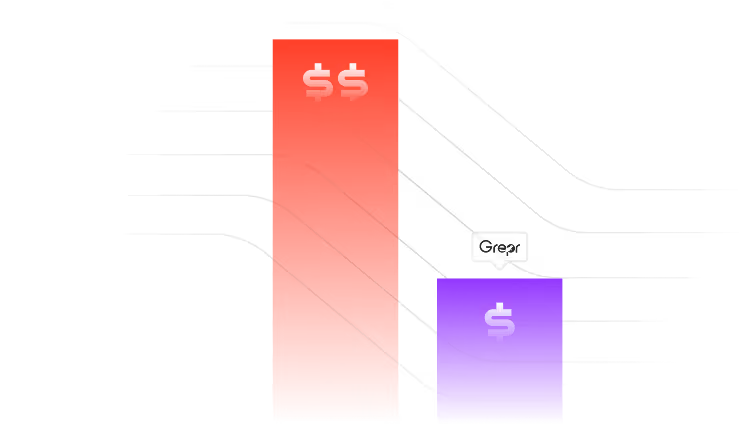
Expensive bills force you to drop data
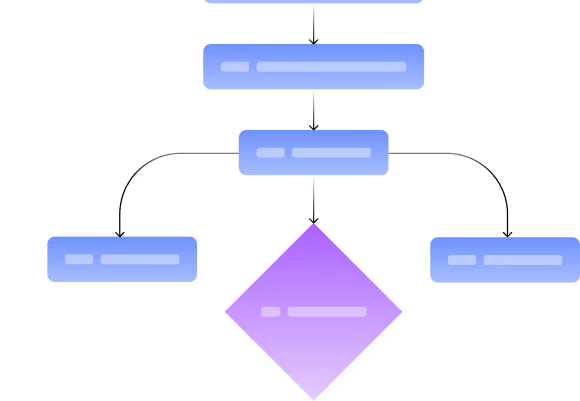
Teams build toilsome pipeline rules that drop data --> incident response is slowed, driving up MTTR
Cut telemetry noise without losing visibility
Grepr’s Autonomous Telemetry Pipeline automatically reduces telemetry noise by 90%, keeping raw data in low-cost storage, available for immediate backfill.



Less noise.
More confidence during incidents.
Decrease telemetry noise by 90%
Grepr’s signal processing engine automatically eliminates telemetry noise before it reaches your observability platform — no manual rules, no migrations required.
Collect everything
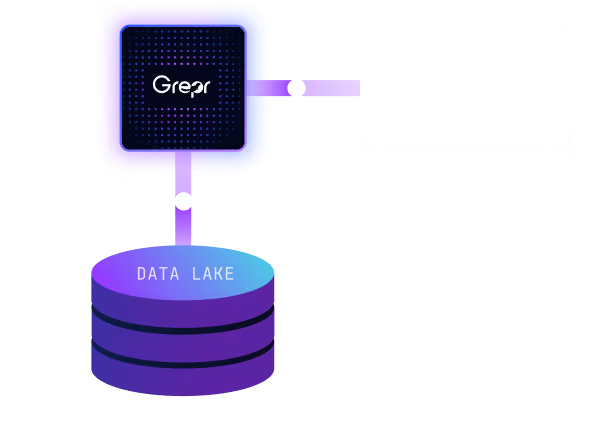
Because Grepr sends noisy data to low-cost storage, you can afford to collect as much telemetry data as you want, eliminating blind spots without driving up your observability bill.

Full fidelity when you need it
During an incident, raw data is automatically backfilled into your observability platform. So you always have access to the full picture when it matters, without paying to index it continuously.
Focus on your business instead of observability
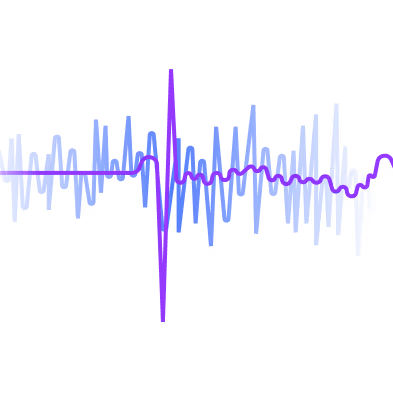
Stop tuning agents and governance rules. Grepr detects millions of patterns, signatures, and trends dynamically, instead of relying on static, toilsome rule-building by engineering.
How Grepr solves the limitations of traditional approaches
Instead of collecting less
Creates blind spots, and developer adherence is inconsistent.
Collect as much as you want, and let Grepr separate the signal from the noise.
Instead of shortening retention
Creates blind spots during outages, and compliance may mandate longer retention.
Keep raw telemetry in a low-cost data lake and back-fill data to assist investigations.
Instead of sampling or dropping data
Requires months of engineering resources, and arbitrary dropping leads to blind spots.
Collect everything, and let Grepr’s signal processing engine automatically separate signal from noise.
Instead of observability reviews
Observability cost reviews and quota negotiations slow down deployments.
Collect everything and ship now.
Reduce telemetry noise at scale

“We were skeptical that something could reduce our log volume that aggressively without us feeling it somewhere. The fact that our developers haven't noticed a change in how they work is the result we were hoping for.”


How CustomInk Cut Their CloudWatch Bill by 85% Without Impacting Dev or Ops

"Grepr helped us automate what to keep and what to skip, so we’re not paying to store or index noise. It lets us find the needle in the haystack without paying for the haystack!"


How Jitsu Cut Logging Costs by 90% While Managing Millions of Shipments Generating 400 Logs Each

"Since we deployed Grepr, we’re seeing a 95% reduction in log volume and didn’t have to change a thing in our app. I'd recommend Grepr to any team that's experiencing rising costs from an expensive logging platform!"
.webp)

Case Study: How FOSSA Reduced Their Logs by 95% Without Burdening Their Engineers

“Engineers didn't change how they work at all. Dashboards and alerts still worked as expected. We just stopped paying for 90% of our log volume that was never doing anything for us.”

9 Days from Kickoff to Production: How Envoy Cut Log Volume by 90%
“After seeing what Grepr did to reduce our logs noise, extending it to traces was an easy call. We were seeing the same pattern: a lot of volume, most of it not particularly useful, and a Datadog billing model that scaled with every new host we spun up.”

How Envoy Cut Log Volume by 90%
“We were skeptical that something could reduce our log volume that aggressively without us feeling it somewhere. The fact that our developers haven't noticed a change in how they work is the result we were hoping for.”
"Grepr helped us automate what to keep and what to skip, so we’re not paying to store or index noise. It lets us find the needle in the haystack without paying for the haystack!"
"Since we deployed Grepr, we’re seeing a 95% reduction in log volume and didn’t have to change a thing in our app. I'd recommend Grepr to any team that's experiencing rising costs from an expensive logging platform!"
“Engineers didn't change how they work at all. Dashboards and alerts still worked as expected. We just stopped paying for 90% of our log volume that was never doing anything for us.”
“After seeing what Grepr did to reduce our logs noise, extending it to traces was an easy call. We were seeing the same pattern: a lot of volume, most of it not particularly useful, and a Datadog billing model that scaled with every new host we spun up.”


FAQ
Reducing log volume means lowering the amount of log data that is sent, indexed, stored, or retained in expensive observability platforms. The goal is to reduce repetitive or low-signal log volume without losing the raw context teams need for incidents, debugging, compliance review, or historical analysis.
Log volume grows as teams add more services, environments, releases, and telemetry sources. Developers add logs to understand how systems behave, but repeated events, debug noise, and high-cardinality application behavior can send large amounts of low-signal data into observability platforms.
Grepr reduces log volume by identifying repetitive, low-signal log patterns before they reach downstream observability tools. Grepr forwards useful signal and summaries to existing platforms while preserving raw logs in a low-cost data lake for incidents, investigations, and historical context.
Grepr analyzes logs as they pass through and identifies repeated message shapes. Once a pattern becomes noisy, Grepr can summarize repetition instead of sending every repeated line downstream at full premium-ingest cost.
Not with Grepr’s recommended approach. Grepr sends low-value, noisy observability data to a lost-cost data lake, which can backfill your observability platform as-desired. This helps you lower costs without creating the same blind spots that can come from simply dropping logs or sampling too aggressively.
Grepr can be configured to avoid aggregating specific words, fields, or attributes. Teams can preserve or group by values such as IDs, IP addresses, status codes, URL paths, services, and environments when those values matter for troubleshooting or analytics.
Yes. Grepr can pull numeric values from repeated messages and summarize them for downstream tools. For example, repeated log messages with a bytes-processed field can be summarized as an aggregate value.
Yes. Grepr can support teams using Datadog by reducing repetitive log volume before being sent to Datadog.
Grepr is designed to work with existing observability platforms and telemetry workflows.
The safest way to reduce observability costs is to ensure low-value, noisy logs are accessible in a low-cost data lake, in case they’re needed during an incident. That means avoiding blunt approaches like dropping data permanently or forcing developers to log less.
Grepr is a strong fit for platform, SRE, observability, and engineering teams that want a scalable and automated platform that eliminates low-value, noisy logs in order to reduce their observability TCO by up to 75% without needing to migrate from existing observability tooling.
Yes. Grepr can backfill logs automatically during an incident, or as-needed during an investigation
Ready to reduce your observability TCO by 75%?
Reduce telemetry noise in your observability tools. Instantly search or backfill raw data.