

Closing the Loop: Why Self-Healing Operations Need Better Detection
AI can act. Can your systems tell it what matters?
Explore how complete telemetry, adaptive detection and governed response work together to help teams find issues beyond existing alert coverage.
The gap between finding and fixing in engineering
An AI SRE can help investigate an issue and support a response. But the quality of that work depends on the signals and context it receives. When telemetry is missing, or a new failure falls outside existing monitoring coverage, your customers will notice before you know there's a problem.
This guide explores how to connect observation, detection and response, and how to check whether the action taken actually worked.
What you'll learn inside
Process the telemetry you need while preserving raw evidence for deeper investigation.
Recognize meaningful changes, validate findings and turn what you learn into ongoing monitoring.
Give people and agents the context to act within defined permissions, then verify the outcome.
Where does your team stand?
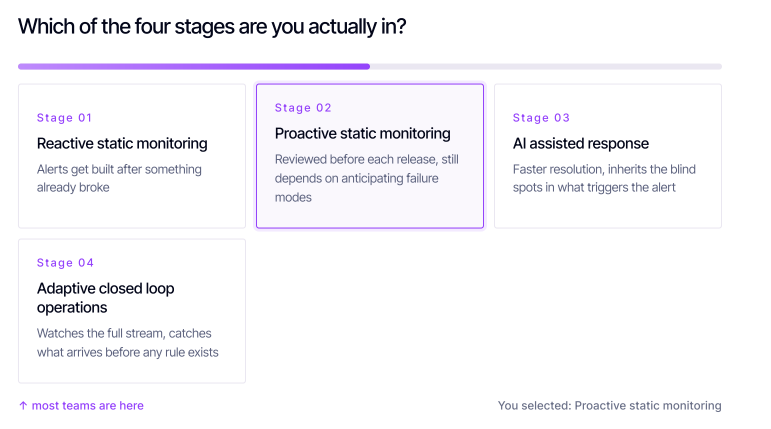
Use the readiness questions to identify gaps in telemetry access, alert coverage and response workflows. Then compare your approach with four stages: reactive static monitoring, proactive static monitoring, AI-assisted response and adaptive closed-loop operations. The guide includes practical steps for the next 90 days.
FAQs
An AI SRE is an AI-powered system that supports site reliability work, such as investigating production issues, gathering evidence and recommending or executing approved actions. Capabilities vary. Its effectiveness depends on the telemetry it can access, how work is triggered and the controls governing its actions.
Anomaly detection identifies behavior that differs from an expected pattern. In production systems, this might be a new log pattern, a change in frequency or an unusual relationship between signals. An anomaly is a reason to investigate; it is not automatically proof of an incident.
MTTD measures how long it takes to detect an issue. In this guide, MTTR describes the time from detection to resolution. Improving response speed does not eliminate the need to find issues sooner. Define the timestamps consistently when measuring either metric.
Look at telemetry coverage, detection triggers, evidence quality, allowed actions, approval requirements and how outcomes are verified. The whitepaper helps you assess how these pieces connect and where to focus next.
Grepr is designed to work alongside existing observability platforms, AI SRE agents and response processes. The guide explains how improving the signals feeding those tools can strengthen the overall workflow.
Ready to learn more?
See how the Grepr AI harness allows you to build and run proactive operational agents on live telemetry.