Signals
Alert Fatigue: What It Costs Engineering Teams in 2026
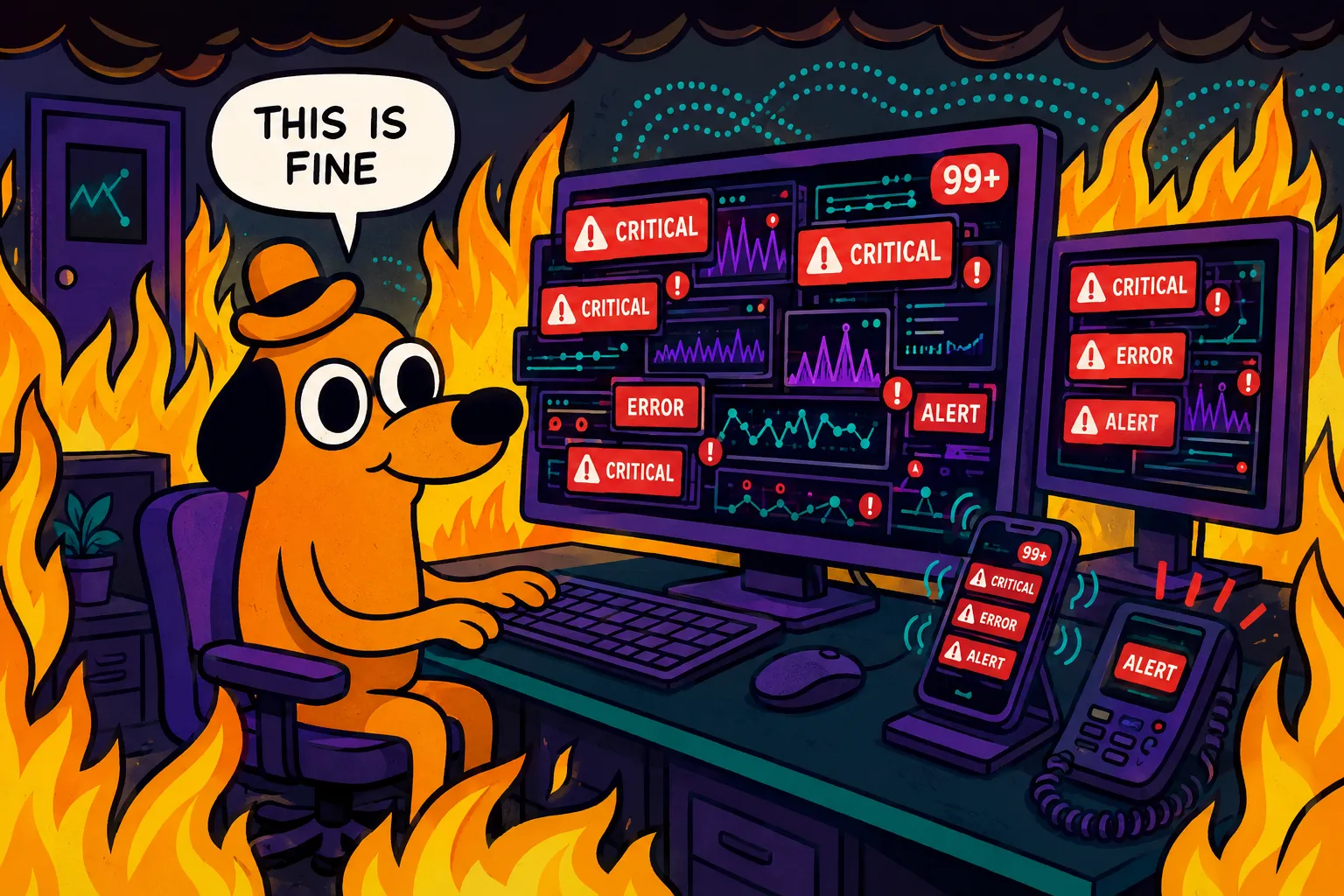


Every on-call engineer collects the same story eventually, and it always starts the same way. A pager cries wolf so many times that the village stops bothering to look up, and the one night an actual wolf strolls past, everybody sleeps clean through it. Alerts, like certain houseguests, wear out their welcome fast. The rude ones simply page more often while they do it.
Alert fatigue is the polite name for what happens next: a team that has learned, correctly, that most of what buzzes its way is nonsense, and starts treating everything that buzzes accordingly, including the one alert that finally means business. It is a wholly rational response to an irrational amount of noise, which is the most annoying kind of problem to have, since everyone involved is behaving with perfect logic the entire time. They are simply responding sensibly to a system that keeps crying wolf on a schedule, which is a fine description of how alert fatigue takes root in the first place.
Below are the causes of alert fatigue worth diagnosing, the cures that address them directly, the costs worth putting a number on, and where a team can start cutting alert noise this week rather than at the next planning cycle.
1/ Cause: every alert shouts at the same volume. A healthcheck blip that heals itself in ninety seconds gets the identical tone, urgency, and 3am wake-up privileges as a queue depth spike that means checkout is dying. Google's own SRE book is refreshingly blunt about this in its chapter on monitoring distributed systems, arguing that every page should demand real human judgment, reserved for conditions serious enough that only a person can decide what happens next (Google SRE book, "Monitoring Distributed Systems"). A self-healing blip clears that bar about as often as a cat clears a bathtub.

Cure: tier alerts by what they truly require. Reserve the loudest tone and the fastest escalation for conditions that really earn it, and let everything else land somewhere quieter, a dashboard, a ticket, a channel built for daylight hours. This single change does more to reduce alert noise, and to reverse alert fatigue overall, than almost anything else on this list.
2/ Cause: one failure pages from five different directions. A single broken payment service can trigger the message broker, the service's own dashboard, the load balancer, and two synthetic checks, each with its own wording and its own idea of how urgent this is. It is the on-call equivalent of five relatives calling about the same minor fender bender, each certain they are the first to break the news.
Cure: consolidate before you correlate. Collapse the five pings into one incident with one page. Reducing that duplication is one of the fastest ways to reduce alert noise available, since it tackles volume directly instead of asking a half-asleep brain to do the correlating manually.
3/ Cause: alert rules get configured once at launch and then treated like a load-bearing wall everyone is scared to touch. A noisy healthcheck alert can survive three separate retro mentions, get logged as a follow-up ticket each time, and still be paging someone eighteen months later, because deleting it stayed permanently unclaimed as a job.
Cure: give every alert an owner and a review date. Alerting best practices treat each rule the way a team treats any other piece of production code: someone owns it, it gets reviewed on a schedule, and once ninety days pass without the alert being acted on, it gets deleted or downgraded to a channel reserved for regular business hours.
4/ Cause: the fatigue itself, compounding quietly. A survey of 1,855 ITOps and engineering professionals in Splunk's State of Observability 2025 report found that 43% of respondents spend too much time responding to alerts, and 73% report an outage caused specifically by an alert that got ignored or suppressed (Splunk, State of Observability 2025). Somewhere around the eleventh false alarm, a perfectly rational engineer starts doing the math the alerting system should have done first, and stops trusting the pager to tell the truth.
Cure: measure the ratio, alongside the volume. Track how many alerts fire against how many turn into real incidents, and watch that ratio the way a sensible person watches a thermostat rather than waiting for the room to become unbearable. A degrading ratio is the earliest honest warning sign alert fatigue offers, and it shows up weeks before anyone sleeps through a page that mattered.
Alert fatigue rarely shows up on a balance sheet with its own line item, which is exactly how it gets away with costing so much.
A February 2026 survey of 1,039 SRE, DevOps, and IT operations professionals found that 77% of on-call teams receive at least ten alerts a day, and 57% report that fewer than 30% of those alerts turn out actionable (NeuBird AI, 2026 State of Production Reliability and AI Adoption Report). The same survey found that 83% of engineers admit to ignoring or dismissing alerts at least occasionally, and 44% of organizations had an outage in the past year tied directly to a suppressed or ignored alert. Read together, the picture is a team spending most of its attention on alerts that ask barely anything of it, while the fraction that matter compete for the same sliver of trust as everything else, which is a strange way to run a fire department.
Some of that cost shows up as toil rather than outages. Catchpoint's SRE Report 2025, based on a survey of over 300 reliability professionals, found that the median share of an engineer's week spent on operational toil climbed to 30% in 2025, up from 25% the year before, the first rise in five years (Catchpoint, The SRE Report 2025). Sorting real signal from noisy alerts qualifies as exactly the kind of repetitive, manual work toil describes, and every extra point of the week spent doing that sorting by hand is a point unavailable for anything more interesting, including sleep.
The number that matters most rarely fits in a spreadsheet anyway. It is the threshold at which one particular engineer's brain quietly decides a given alert has cried wolf one too many times, and stops treating it as worth a second look. Every team carries some version of that threshold. Alert fatigue is what happens once a team crosses it while remaining pleasantly unaware of exactly where the line sat.
The fixes above hold up fine individually, but a team trying all of them at once should start with the two that pay off fastest against alert fatigue.
Audit the alert-to-incident ratio first, since it tells you exactly where the noise concentrates rather than leaving anyone guessing. Then tier the loudest offenders, the alerts firing daily against incidents that occur monthly are the equivalent of a smoke detector that goes off every time someone makes toast. Everyone eventually just takes the battery out, and a team that removes its own batteries has cured the beeping and reintroduced the fire risk in one elegant move.
All of it fits inside a team's existing headcount, with zero platform migration required. It asks for treating alerting rules as a living system that earns continued trust, rather than a configuration decision made once and abandoned to fossilize, which is roughly the same discipline good gardeners apply to houseplants and good managers apply to org charts. Teams that keep this discipline going tend to see alert fatigue shrink steadily instead of resetting to zero once and creeping back within a quarter.
Everything above assumes a team has the spare hours to tier alerts, consolidate duplicates, and audit ownership by hand, on top of the actual job. Most teams run short on exactly that kind of spare time, which is precisely why a known noisy alert can survive three retro mentions without anyone deleting it. The underlying noise, sitting in logs, metrics, and traces, keeps growing faster than any team can manually keep pace with, and every alerting rule sits downstream of that volume, inheriting whatever mess arrives from upstream.
Grepr works upstream of the alerting layer itself, ahead of whatever a team already runs, Datadog, Splunk, New Relic, or Grafana Cloud. It identifies repetitive, low-signal patterns in the telemetry feeding those alerts before any of it reaches a dashboard or a threshold. Instead of an engineer hand-writing and maintaining rules to catch duplicate signals, Grepr's models learn the noisy patterns on their own and keep adapting as new services ship, which means the alert that would have paged five different tools for the same failure gets summarized upstream instead of arriving as five separate pings demanding five separate glances. The full raw stream stays archived automatically to low cost storage for the rare case an investigation needs it, and truly unusual events keep passing through untouched, the way they should. Most teams see a 75 to 90% drop in the volume hitting their observability platform after a single config change, and the alerts that remain carry more weight simply because far less noise competes with them for attention.
Fewer alerts that carry real weight is the entire point of fighting alert fatigue, and it happens to be the same wedge that makes Grepr worth a look for any team still tiering thresholds by hand at midnight. Grepr gets a team there without asking anyone to hand write another rule, follow another set of alerting best practices manually, or sit through a fourth retro about the same noisy healthcheck.
See how much of your own alert volume is noise before it reaches a human. Book a demo: https://www.grepr.ai/schedule-a-demo