Announcements
Introducing Grepr AI: The harness for proactive operational agents



Nobody believes operations will look the same five years from now. Yet most teams still run production with tools built for hand-coded microservices on container infrastructure: dashboards, alerts, SIEM detections, and parsers, each written by someone who predicted what could go wrong.
That model is breaking. Coding agents ship more code, faster, than any team can review line by line. Attackers use the same tools to find new ways in. Production now changes faster than anyone can write rules for it. SREs and security teams were already overwhelmed, and with AI their load increased by orders of magnitude.
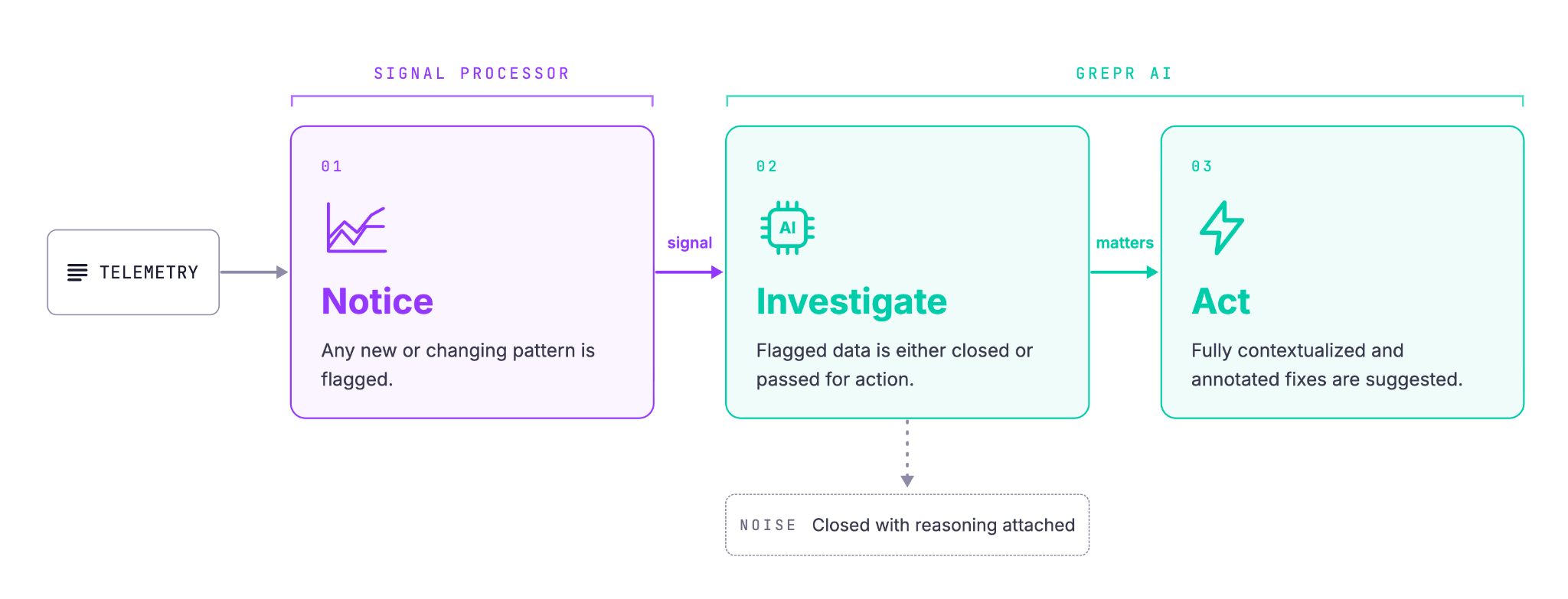
Today we're introducing Grepr AI, the harness for proactive operational agents. Grepr AI powers up platform, SRE, and security teams to take back control. Grepr AI agents run on live telemetry streams, notice every new or changed pattern the moment it appears, and investigate and fix what matters at the source. With minimal setup, your agents start catching what other tools miss and reacting to changes in your environment the moment they happen.
For years, operations has depended on people predicting failure modes in advance and encoding each one as an alert rule. Every alert, SIEM detection, and parser encodes a lesson someone already learned. That's why known problems rarely take you down. The incidents that bring systems down are the ones no one knew to create an alert for that catches leading indicators, rather than SLOs or other lagging indicators.
Grepr’s signal processor flips that model: it spots new and changing patterns in your telemetry in real time, with no prediction required. AI already transformed how software gets written; this is AI coming to operations, so you can keep pace with how fast your code ships.
On the reliability side, faster delivery means more failure modes nobody has seen before, harder diagnosis when they hit, and more alert rules than anyone has time to write. Indexing costs push teams to drop data, which opens blind spots exactly where new problems hide. Too often, customers find the problem first: 41% of leaders still learn about service interruptions through customer complaints, incident tickets, or manual checks rather than automated monitoring (New Relic, 2025 Observability Forecast).
On the security side, the gap looks the same. SIEM rules cover standard logs, not the custom applications your business runs on. A token written to an access log throws no error and trips no threshold; it just gets copied to every tool downstream. AI-driven attacks and agent jailbreaks behave in ways no static rule anticipates.
Underneath both, the telemetry itself drifts. A field renamed upstream doesn't move an error count, but it quietly breaks the dashboards, alerts, and detections that depend on it.
Most AI tools for operations don't change this picture, because they start working when an alert fires. If nothing fires, they never start.
Grepr AI is a harness for building and running proactive operational agents. Instead of waiting for an alert, Grepr agents notice the moment something changes in your telemetry, in addition to predefined alerts. Grepr agents find, investigate, explain, and fix what no alert, rule, or detection was built for, across performance, reliability, and security data.
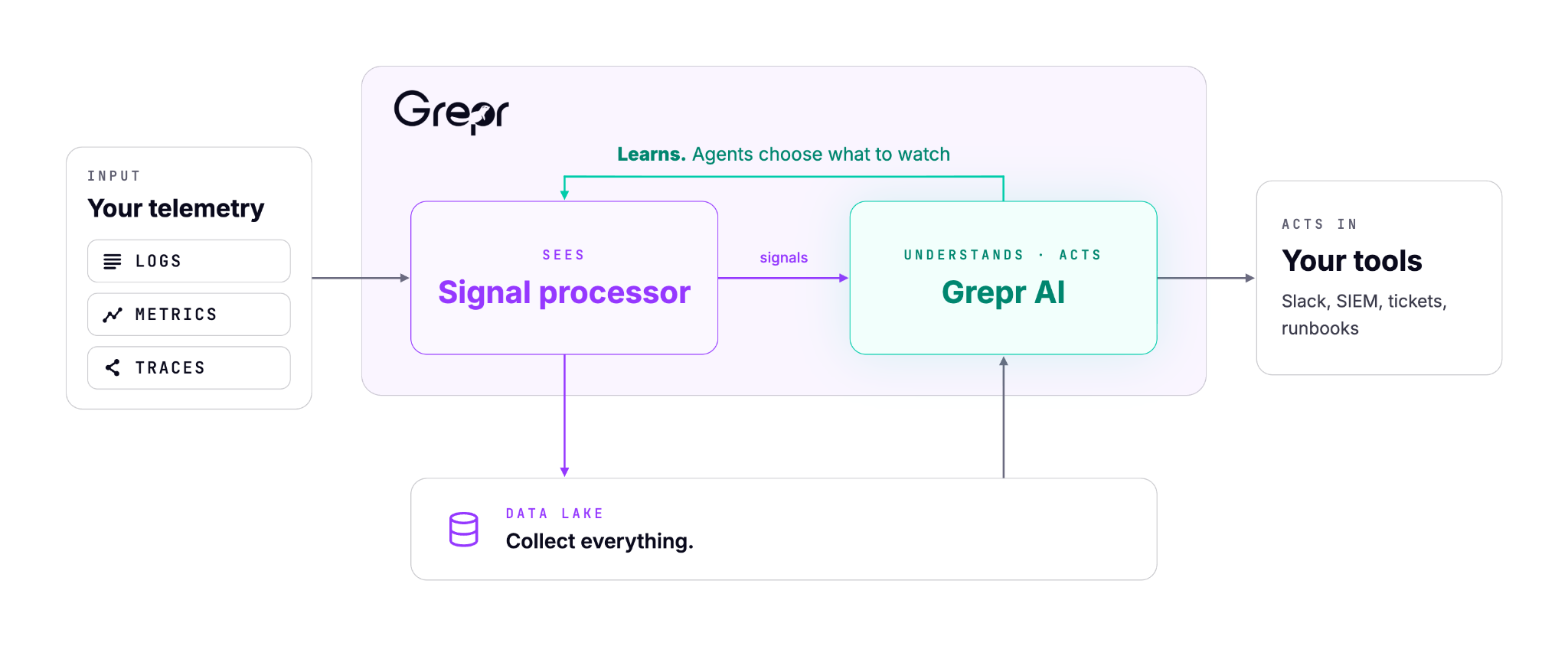
What makes that possible is the foundation underneath: Grepr's signal processor. It sits between your telemetry sources and the tools you already use, and it fingerprints every log pattern in the stream before it's indexed. When something never seen before appears, or a known pattern changes shape, it becomes a signal for your agents. No alert, rule, or threshold required.
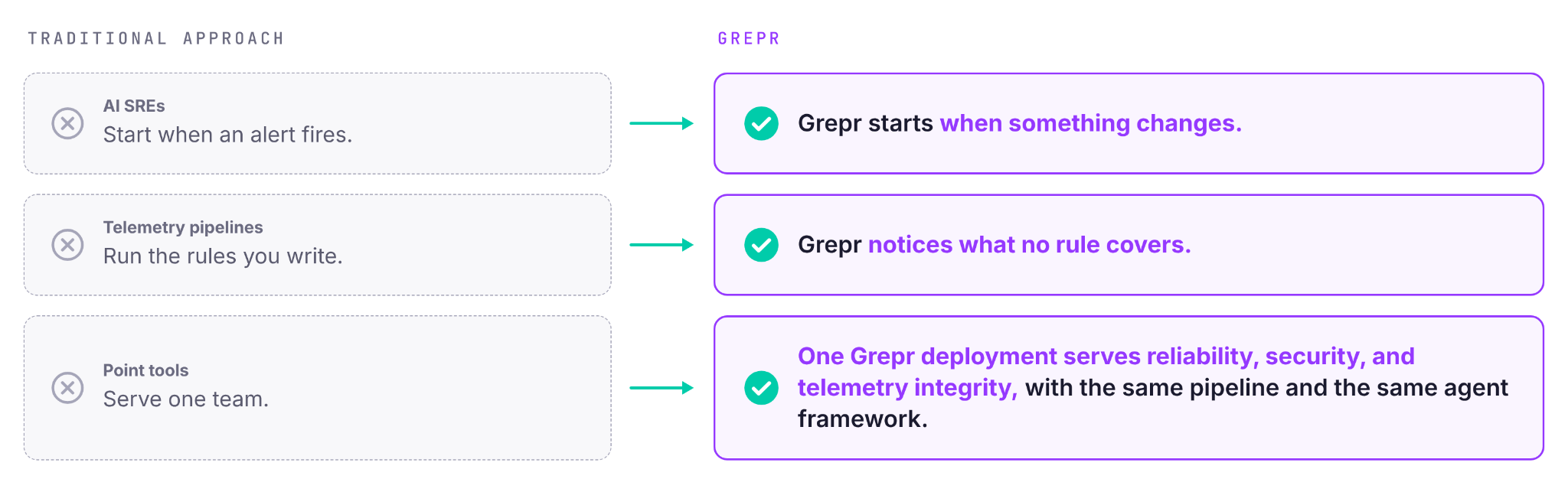
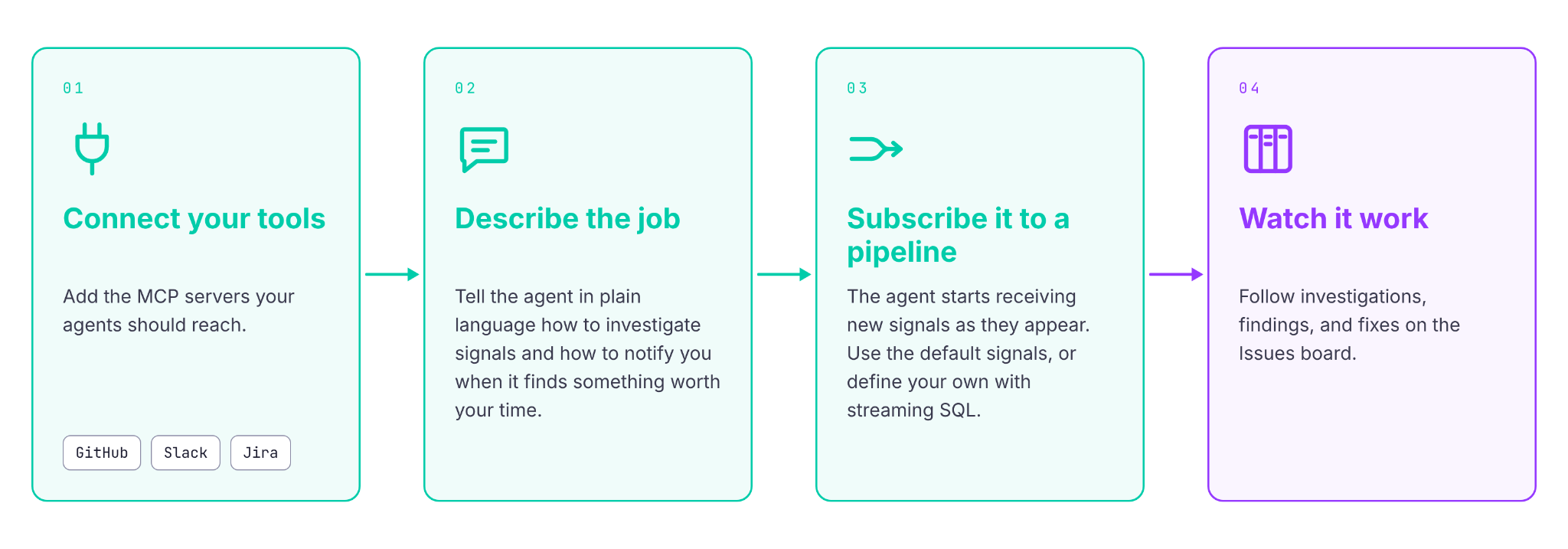
And because every environment fails in its own way, Grepr doesn't hand you a fixed set of agents. You describe the job in plain language, and Grepr gives the agent the signal, memory, tools, and guardrails to do it. Starter prompts help you begin.
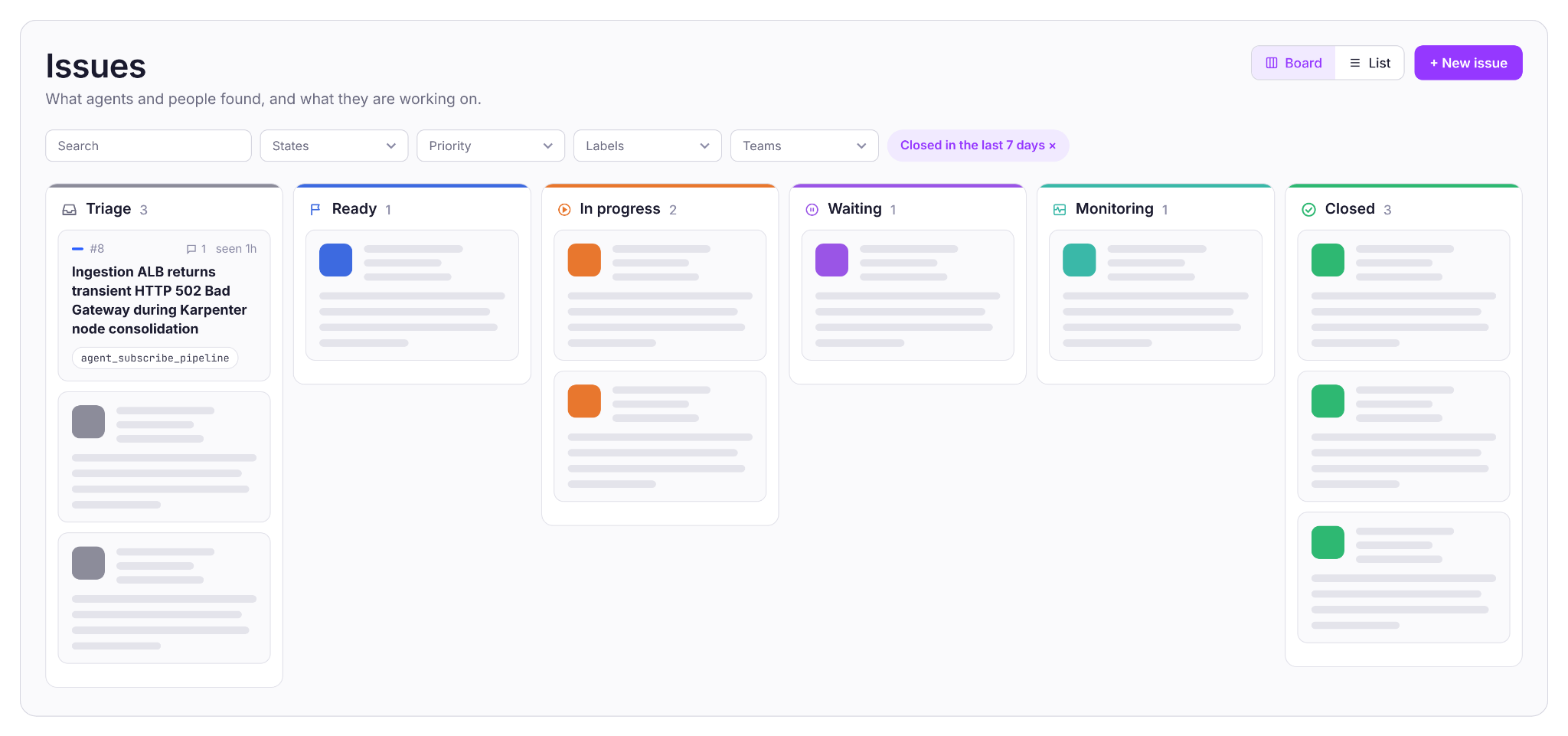
Every finding lands on the tightly integrated Issues board, where your team and your agents work it together. Agents also record what they learn, so each investigation starts with the context of the ones before it.
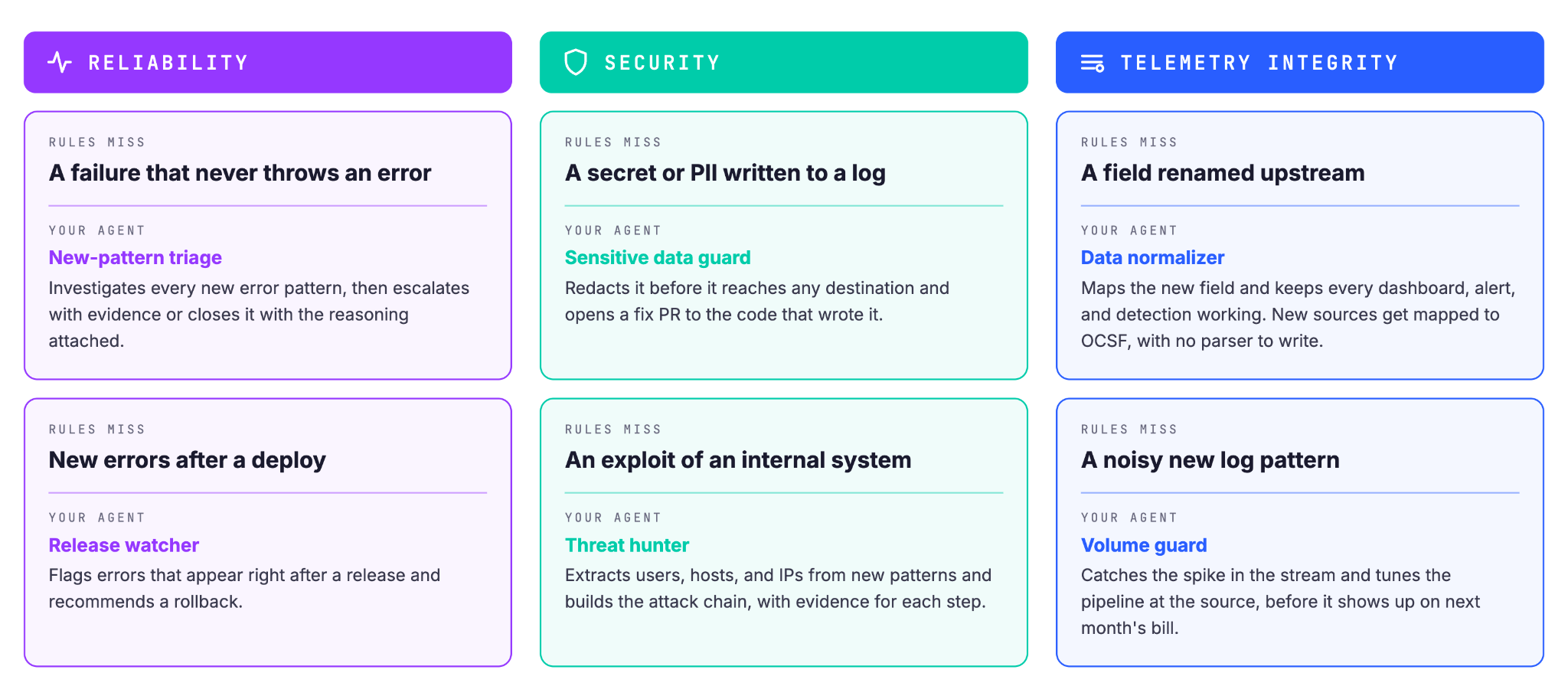
Each of the following are examples of agents a team can build in minutes, spanning reliability, security, and telemetry integrity.
Build an agent in minutes
You already use coding agents to build your software. Use Grepr to build agents that help you run it in production.
You set the guardrails. Agents reach only what their identity, tools, and MCP connections allow. Every investigation records what the agent looked at and why it decided what it did. Pipeline changes are dry-run against live traffic, then applied automatically or queued for approval; you choose per agent.
Already running agents? Your AI SRE, AI SOC, and coding agents start when something flags a problem. Grepr flags what nothing else does. Connect them to the Issues board, and they work the issues Grepr finds alongside your Grepr agents.
Before sharing Grepr AI with anyone, we ran it on our own production logs for 30 days. It ran 17K investigations and raised 20 issues that needed a human. Everything else closed with its reasoning attached, and the typical issue went from first signal to diagnosis in Slack in a couple of minutes.
Read the full story: 30 days on call with Grepr AI
Running agents on all your telemetry sounds expensive. It isn't, because agents never read the firehose. The signal processor collapses raw telemetry into patterns and sends only new or changed ones to your agents, so agent cost tracks novelty, not volume.
The same signal processor cuts observability costs 90%. It compresses noise before it reaches Datadog, New Relic, Splunk, Dynatrace, Grafana, OpenTelemetry, Amazon CloudWatch, and other platforms, while every raw event lands in your own low-cost storage in open formats. Your existing dashboards and alerts keep working.
You don't need Grepr AI to start, either. The signal processor works on its own, and Grepr AI is there when you're ready to put agents to work. Calculate your savings.

We opened with a simple claim: nobody believes operations will look the same five years from now. We don’t know exactly what it will look like, but we’re confident about the direction: agents that work directly on live telemetry, built by describing the job in plain language, catching what nobody predicted. Rules, dashboards, and alerts aren’t going away; they’ll keep encoding what teams already know, while agents take on what no one saw coming. Grepr works alongside the tools you already run, so you can start today without replacing anything, and we’d love your help shaping what comes next.
Grepr AI is a harness for building and running proactive operational agents. Instead of waiting for an alert, the agents run on your live telemetry, notice the moment a new or changed pattern appears, and investigate and fix what matters, across reliability, performance, and security. You describe the job in plain language, and Grepr gives the agent the signal, memory, tools, and guardrails to do it.
Most of those start working only when an alert fires, so if nothing fires, they never start. Grepr’s signal processor fingerprints every log pattern before it’s indexed and flags anything new or changed in real time, which means your agents can act on what no rule anticipated. It works alongside the tools you already run, and you can even connect your existing AI SRE or SOC to the same Issues board.
No, because the agents never read the firehose. The signal processor collapses raw telemetry into patterns and sends only the new or changed ones to your agents, so agent cost tracks novelty, not volume. The same pipeline cuts observability costs by 90%, and every raw event still lands in your own low-cost storage.