Product Features

Product features and updates that explain how Grepr reduces log volume, sharpens signal, streamlines pipelines, and supports AI-driven observability workflows as the platform evolves.

Product Features

Backfill Brilliance: Cut Observability Storage Costs While Boosting Clarity with Grepr

Grepr reduces observability costs by storing all data in low-cost storage and using machine learning to forward only unique or summarized insights to platforms like DataDog, Splunk, or New Relic. Engineers can query retained data, generate reports, power AI, or trigger dynamic backfill during incidents—automatically via webhooks or manually through the Grepr interface. To learn more or request a demo, visit grepr.ai.
May 23, 2025
Product Features

So… what exactly does Grepr do?

Grepr is an intelligent observability pipeline that sits between your agents and observability platform to optimize, analyze, and route data in real time. By using machine learning and a rules engine, Grepr detects patterns in data streams, holds back noisy or repetitive information, and forwards only essential summaries or unique messages. With a simple configuration change, it integrates seamlessly into existing systems—helping teams cut observability costs by up to 90%, retain data long-term, and make observability insights available for business reporting and AI.
May 21, 2025
Product Features

Avoiding impacts to existing alerts and dashboards with Grepr

Everything we do at Grepr is around making sure we reduce costs with minimal impact to existing workflows. Grepr can automatically parse existing alerts in Datadog (Splunk and New Relic coming up in the next few weeks) and avoid modifying logs that power them. This way, you can roll out Grepr to prod without worrying about having to rewrite all your alerts.
May 19, 2025
Abstract technology visualization showing Splunk Heavy Forwarders in green on the left sending S2S data streams to a central violet hexagonal Grepr compression processor with inward compression arrows, storing complete data in a layered blue data lake below with SPL query access indicators, outputting compressed orange stream with embedded link chain icons and summary document indicators to Splunk platform on the top right, and a dashed blue backfill path connecting the data lake to Splunk on the bottom right for manual data retrieval
Product Features

How to Deploy Grepr with Splunk: Reduce Log Costs by 90%

Grepr receives logs from Splunk Heavy Forwarders via S2S, compresses data by 90% while retaining everything in a queryable data lake with SPL support and one-click backfill to Splunk when needed.

May 16, 2025
Product Features

Automating Log Management

Grepr uses machine learning to reduce log volume without losing visibility. It parses and structures logs in real time, groups similar messages, and applies smart sampling to cut noise. Critical logs still get through, and full raw data is stored separately for easy access during incidents—keeping your backend lean and your team in control.
May 9, 2025
Product Features

Time Travel With Dynamic Backfill

Grepr’s Dynamic Backfill feature lets teams retain all log data at low cost while only sending essential logs to their main logging backend, cutting processing and storage costs by around 90%. Unlike traditional logging that risks missing key data before an incident is detected, Grepr stores everything in affordable storage and allows engineers to selectively backfill detailed logs when issues arise—like turning up log detail after the fact. This ensures engineers have full context for debugging, with no disruption to existing workflows, balancing deep visibility with major cost savings.
May 2, 2025
Product Features

How Grepr Handles Trace Logs

Grepr helps companies lower observability costs while keeping engineers' workflows unchanged. A key feature is its ability to ensure full logs for a sampled set of traces, even with log aggregation and sampling in place. Users can specify how much of their data to sample and provide trace ID paths to identify relevant logs. Grepr's system uses intelligent sampling, backfilling, and a rule engine to collect and process trace logs efficiently. To optimize performance and memory, it evolved from a basic set-based approach to a scalable design using Bloom filters and a custom resizing Bloom filter. This allows Grepr to maintain high throughput while managing memory use effectively, ensuring reliable trace log visibility.
May 14, 2025
Product Features

Using Grepr To Reduce Logging Costs

Discover how Grepr's intelligent log management solution can reduce your logging costs by 90% without sacrificing visibility. Our two-tier storage system uses machine learning to identify patterns and store less critical logs in low-cost storage, while maintaining immediate access to important data. When incidents occur, Grepr's dynamic backfill feature automatically retrieves relevant logs to your existing tools. Implement smarter logging today without changing your workflows or compromising on troubleshooting capabilities.

April 25, 2025
Animated pixel art of a silhouetted figure running across a stream of colorful data and icons flowing out of a retro computer monitor, surrounded by floating floppy disks and a printer on a teal background.
Product Features

Dirt-Cheap, Infinite, Queryable Log Storage: The Log Data Lake Approach

Storing logs long-term doesn't have to be super expensive. Using a data lake can reduce storage costs by more than 90% while still keeping the logs queryable and immediately accessible.
April 23, 2025
Black and white animated GIF of a large dam with water pouring through multiple spillway gates, illustrating the concept of controlling and managing high-volume data flow.
Product Features

3 Advanced Techniques to Reduce Log Volume by 90% (Part Two)

Three advanced techniques for reducing log volumes by 90% or more, including automatic pattern sampling, logarithmic sampling, and sampling with automatic backfilling, each designed to scale for enterprise environments without sacrificing critical troubleshooting data.
February 11, 2025
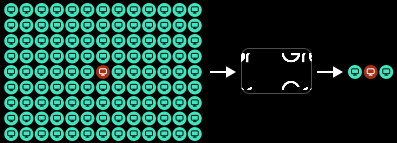
A diagram showing how Grepr reduces host counts: on the left, a grid of approximately 100 host icons with most in green (normal) and two in red (anomalous); an arrow points to the Grepr logo in the center; another arrow points to the output on the right showing only three host icons, representing the aggregated normal hosts and individual anomalous hosts sent to Datadog.
Product Features

Monitored Objects: How Grepr reduces Datadog metrics and host costs

Grepr's Monitored Objects approach groups metrics by entity, aggregates normal behavior, and only sends detailed data to Datadog when anomalies occur, dramatically reducing billable custom metrics and hosts without sacrificing troubleshooting capability.

February 12, 2025
Kayak on a data lake icon
Product Features

6 ways Grepr Optimizes the Logs Data Lake

This blog discusses 6 ways that the Grepr Data Lake is optimized for logs.
April 21, 2025

Get started free and see Grepr in action in 20 minutes.