Product Features
Monitored Objects: How Grepr reduces Datadog metrics and host costs
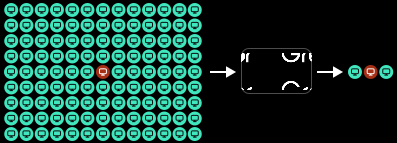


If you’re managing observability with Datadog, you’ve likely noticed two big cost drivers: custom metrics and host counts. Datadog charges based on unique metric time series (i.e. metric cardinality) and active hosts, both of which can get large. At Grepr, we’ve developed a smarter way to manage observability—cutting those costs significantly without compromising developer workflows.
Metrics storage systems (time series databases or TSDBs), are expensive because they offer:
But do all metrics need this level of service? We studied how metrics are used and found four core use cases:
Not every use case requires all TSDB features or all the data all the time, and by aligning metrics service to actual needs, we can dramatically cut costs.
The TSDB (Datadog) is your expensive hot data storage, so Grepr only stores the most useful data there and only when needed. Grepr combines the TSDB with an observability-optimized data lake as a low-cost cold data storage. Grepr automatically manages what data goes to which tier based on the current situation.
Result: If you’re billed by objects, such as hosts, or by metrics cardinality or number of datapoints sent, you’ll see a major drop in your billable items.
Grepr has customizable built-in anomaly detection for host metrics to identify hosts that behave differently from others. Grepr reduces the number of hosts and all their metrics that are visible to Datadog by aggregating all normal hosts together. Anomalous hosts are sent individually along with historical data. You only get billed on anomalous hosts, and the virtual “aggregate” hosts.
Grepr aims to reduce the impact on any existing workflows with a slew of capabilities:
There are many other exciting details to complete this picture, such as clustering of monitored objects by cohort, built-in anomaly detection, and others. Try Grepr free and see what Grepr can do in 10 minutes here.
FAQs
Monitored Objects are logical groupings of metrics by entity type, such as hosts, containers, jobs, AI models, or HTTP requests. Grepr applies built-in anomaly detection to these objects to identify abnormal behavior, then intelligently routes data based on whether the object is behaving normally or anomalously.
Grepr aggregates all normally-behaving hosts into virtual "aggregate" entities, sending only summarized data to Datadog. When a host becomes anomalous, Grepr sends its individual detailed metrics along with historical context. You only pay for anomalous hosts plus the aggregate virtual hosts, rather than every host in your infrastructure.
No. Grepr stores full-granularity raw data in a low-cost observability-optimized data lake. When an anomaly occurs, Grepr automatically pulls relevant historical data from cold storage and sends it to Datadog for complete visibility. For capacity planning and optimization work, full metrics remain accessible in the data lake for as long as you need them.
Yes. Grepr can automatically detect metrics used in your existing alerts and dashboards and allow them to pass through unmodified. Grepr also supports Datadog-compatible query syntax, so your team does not need to learn a new query language.
Instead of running periodic queries against the TSDB, Grepr uses stream processing to detect anomalies in real time before data reaches Datadog. This approach enables more powerful unsupervised machine learning detection while eliminating the need to store all metrics in expensive hot storage just for alerting purposes.